
Tricking my brain into being productive
Have you ever procrastinated important tasks like scheduling doctor appointments? Have you ever abandoned a game that you enjoy playing and actually want to finish? Have you ever excitedly started work on a project for a few days just to suddenly never touch it again?
I struggled with all of these things for most of my life and it sucked. I felt like I was stuck in an infinite loop. Never able to do the things I want to do consistently. Always a slave to doing these things when my brain suddenly decided it was time. On the bright side, when that did happen then I would be able to lock in and get a lot of progress done. But it would always be for a short burst of time and it would be anyone’s guess when I would come back to it again with that same energy.
I might have continued this way until the day I died. But one day out of sheer dumb luck the youtube algorithm blessed me with a video that has without exaggeration changed my life (and I hate saying that because it sounds so cliche). This video is: I tracked my habits for 300 days and it changed my life by Peter McKinnon.
I don’t know much about Peter, but I thank him for this video. This came to me at a time where I had just become recently unemployed in early 2025. It introduced me to 2 very important tools that I continue to make use of a year later. Journals and Field Notes. To be fair, I tried journaling 2 times in the past previously, but it never stuck. What I failed to make use of before was a proper task tracking system. This was the key piece to the puzzle that I needed in order to gain control over my brain and trick it into being consistently productive. And it forms the basis of what I’ll call The Tortoise Method.
At a high level
Before I get into the details of the tools at my disposal, let me introduce this process at a high level.
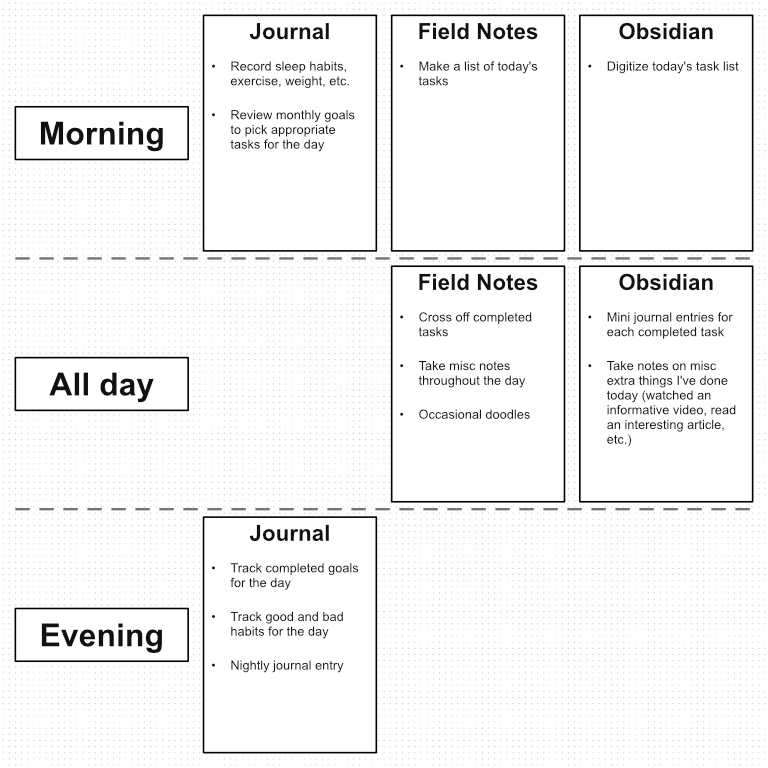
There are 3 tools that I use every day to keep myself productive. The first 2 I already mentioned: Journaling and Field Notes. The 3rd is the application: Obsidian.
The Journal is where I write daily entries, track my habits, and track my monthly goals. I open up my journal in the morning and in the evening. My Field Notes notebook is just that, a book for notes. I carry it with me everywhere to take random notes. And most importantly, I open it up in the morning to create a list of tasks I want to complete for the day. Obsidian is where I digitize my tasks and store my second brain.
Some things will be duplicated across multiple tools. For example, I write my daily tasks first in my Field Notes by hand, and then digitize them to my daily Obsidian note. I will also do mini journal entries everytime I complete a task in Obsidian, and later in the evening I might write some more thoughts on those completed tasks. This duplication helps me better remember the things that I’ve done or help cement things that I’ve learned.
Journals
My journals function as any traditional journal for writing daily entries, but in addition they contain tools for habit tracking and monthly goal tracking. My journal of choice is a Leuchtturm medium (A5) notebook which has 123 pages. This generally gives me 3 months of usage as long as I stick close to my soft rule for journal entries never being longer than 1 page long. This limitation is also nice because it helps me focus on writing about what I think is most important, and it helps me avoid journaling ever feeling like a chore.
At the beginning of every month I go through a ritual of setting up my journal. At an overview I setup a page for:
- The name of the month and a small tab at the top for quick indexing
- A list of interesting things that have happened each day
- The habit tracker and the sleep tracker
- The task tracker and the people tracker
- My goals list
- and the end of the month goals review
And after that group of pages comes each daily entry until I reach the end of the month and start the whole process over again.
Habit tracking
The first 2 pages after the title page contain a list of interesting things that have happened each day, the habits that I want to track for the month, and my sleep tracker.
If anything eventful happens on a particular day then I will record a 1 sentence summary of it. This subtly acts as an indicator to me about whether or not I am making the most of my time in life. If I’m having uneventful months, then that’s a sign to me that I should be getting out more often and experiencing more with my life.
For habit tracking I like to track any habits that I want to positively reinforce, or gradually phase out. For example, one of the most important habits that I track is “Tasks.” This actually ties into my goals; it tracks whether I have completed all of my tasks for the day. At the beginning of the day I will shade in half of the square after I have made my task list. And then my goal for the day is to complete all of my tasks so that I can finish filling in the rest of the square in the evening. In this case this is a positive habit that I want reinforce, so by the end of the month I want to see all of the squares shaded in. I’ve basically gamified getting my tasks done so that I can be productive. There have legitimately been days where I was feeling lazy in the evening and wanted to stop, but I knew that if I didn’t push myself and finish my tasks then I would end up with an incomplete square. And the thought of having that blemish and breaking my perfect month of getting tasks done was enough to push me and finish up my tasks for that day.
For negative habits that I want to break, I don’t want to see any of the squares shaded in by the end of the month. The negative habit that I continue to struggle with is procrastination. I haven’t had a month yet where I had zero squares shaded. But every day that I notice that I’m about to procrastinate, I think about my journal and think about the fact that if I continue and allow myself to procrastinate, I’m going to have to shade in a square. There have been some days where that thought was enough to stop me from procrastinating. But there are plenty of days where I still end up procrastinating. It’s a work in progress and I’m confident that one day I’m going to achieve zero procrastination for an entire month.
Goals tracking
The next 2 pages contain a task tracker for tasks related to my monthly goals, the people tracker, and a list of my main goals for the month.
At the beginning of each month I spend some time thinking about what goals I want to accomplish for that month. Most of these goals are ongoing and rollover every month that I’m still working toward it. These goals usually follow a similar set of rules:
- Don’t miss X consecutive days of working on goal Y
- Work on goal Y for at least X days this month
The first rule is probably the most effective rule for keeping me productive. For example, if I say that I cannot miss 2 consecutive days of working on a goal, that essentially means that I need to work on a task that furthers that goal at least every other day. This means that I end up working toward this goal for at least half of the days in the month. The leeway of being able to work on the goal every other day is nice because it prevents me from burning out which might happen if I had to work on it every day.
The second rule gives me some different benefits than the first rule. It gives me a little more freedom about when during the month I want to work on that goal. However, it comes with some dangers as well. With freedom comes the danger to procrastinate. Let’s say for example that I had a goal to work on for at least 10 days of the month. For me, I can very easily fall into a trap of not working on that goal for the first 2/3rds of the month, and then realizing that I need to work on this goal every day for the remainder of the month so that I don’t fail it. Having to lock in like that for the remainder of the month can be a bit stressful. I use this rule sparingly, or on goals that I enjoy working on and feel confident that I’m probably going to work on it most of the month anyway.
The other section of these 2 pages is what I simply call the “people tracker”. It’s a way to help me be more mindful about maintaining relationships with people in my life. For me this can be a problem because I am so introverted and keep to myself so often. This tracker helps remind me that I should reach out to my friends and family more often if I haven’t in a while. This is still a big thing that I struggle with to this day, but I’m hopeful that this tracker will gradually help me improve.
Field Notes
Field Notes are a brand of pocket notebooks that I’ve come to love. I love the diverse set of designs and I’m looking forward to the far future where I open up a box of all these colorful looking notebooks to flip through and see what I was up to any given day.
Speaking of which, the main thing I use Field Notes for is writing my task list for the day. I base this task list off of my goals for the month. I take a look at what I accomplished yesterday, and what I still need to accomplish this month. I add any tasks that I absolutely have to do in order to not fail any of my goals, and I add in any additional tasks that I want to work on for the day. In this way, I can fill my day with tasks that I might not necessarily want to do but know that I should, as well as tasks that I’m legitimately excited to work on. This aspect is important because it taps into how my brain works. For me, it’s much easier to convince myself to work on things that I don’t necessarily want to work on by giving myself a carrot on the stick in the form of fun tasks that I can sprinkle in throughout the day. Sometimes I insert a fun task in between “boring” tasks, or sometimes I save the fun stuff for the end of the day to give myself something to work toward.
Another thing that I use Field Notes for is simply jotting notes down or occasionally doodling. I also try and use it as an alternative to pulling out my phone when I’m outside the house. It’s a good way to not get sucked into my phone when I should be present wherever I am.
Obsidian
The final tool that I use to complement journaling and field notes is the application: Obsidian. This is what I use to digitize my task lists, write mini journal entries about my completed tasks, and easily refer back to past events. This is where technology enhances the physical journaling process for me. With Obsidian, I have a new daily note (markdown file) every day that acts as my digital journal. Every daily note has my task list for that day and a section where I can write mini journal entries about the work I did for each task.
I spend time in the morning physically interacting with my journal and writing out my task list in my Field Notes, without the distractions of the screen. And then once I’ve thought through what I want to do with my day, only then do I hop onto the computer to digitize my task list and actually get started with my day. Having a physical and digitized task list is a nice redundancy to have, but I also get to benefit from technology here because I can more easily search through all of my past daily notes for whatever I need. This comes in handy with work in particular because I can look back on my mini journal entries about my work and recall why I made certain decisions, what I was planning on working on next, etc.
My digitized mini journal entries are usually more focused on the facts, i.e. what actually happened, what did I actually work on, what did I finish and not get finished. My entries in my physical journal are usually more focused on emotion, i.e. how did I feel about the events of the day, what are the things that made me feel good or bad, brainstorming what I can do to make sure I have more productive and happy days.
I also extensively use Obsidian’s canvas features when I need to plan things out. I am a visual learner and I can remember concepts much easier if I can visualize how they all connect together. I can go on and on about all the cool features Obsidian has that helps me be productive, but I’ll leave it here for now.
The Tortoise Method
The Tortoise Method is a simple concept: I accomplish my goals one small task at a time, slow and steady over an extended period of time. In the past I always struggled with completing goals because they often felt large and daunting. And when a task seems daunting, my brain quickly shies away and starts procrastinating. One day of procrastination turns into 2 days, which turns into a week, and eventually that goal fades away and I move onto something else. And so, I began a new process.
I set a goal for myself: I want to read through an entire book. Something I haven’t done in years. Instead of trying to read through a whole chapter though, I would instead read through 1 single page. I would wake up in the morning, write in my task list “Read 1 page of this book”, digitize my tasks, and then do this task at anytime during the day where I feel like I want to read. I know that I need to complete this task so that I can say in my journal that I completed all my tasks for the day. So I have motivation coming from that direction. And my brain thinks: “1 page? That’s easy, I can complete that task in like 1 minute! And then I’ll be done and I can do whatever I want for the rest of the day!”.
And this is where my brain falls into my carefully laid productivity trap. Because something that I know about myself is that when I get started working on something, I very easily switch into a mode where now my brain thinks “well while I’m here I might as well read another page. And maybe a few more pages. And wait… this is getting good, I want to keep going.” When I give myself a tiny task like this, I never actually expect to only accomplish that little. The majority of the time I end up going much farther than my initial task.
The tasks in my task list are all like this. They all have one very important job and that is to give me an easy entry point into working on the goals that I want to accomplish. I trick myself into believing that I can complete my task list quickly, and then I make use of my ability to lock into a task that’s already been started.
Every month I have a list of goals that I want to work toward, and every day I generate a task list of these small tasks that will push me forward toward my goals, slow and steady. Some days I only accomplish the minimum tasks I have set for myself, and some days I get more done then I expected and feel really good about myself.
My tasks are free form in that I give myself the freedom to accomplish them in any order. I do not make a strict time blocked schedule because I’ve found that my brain struggles to work within that much rigidity. I like the feeling of being able to choose my own path every day and being able to adapt to whatever the day throws at me. And this system of goals, task lists, habit tracking, and journaling, all form a structure around this freedom so that I’m not so free that I end up wandering out of bounds and procrastinating on things that waste my time.
Imperfection
This entire system of mine is by no means perfect and would probably only work for other people similar to me. I still struggle with procrastination, I still don’t get as much work done as I would like to, and the progress I make is slow and takes time. But compared to the version of me before this entire system, I am so much better off. Before, I was stumbling in the dark with no compass. Now, I can see a path of lights forward.
I’m making some progress minimizing procrastination by making use of tools such as Focus Friend. I’m finally spending time on hobbies that I want to spend time on like learning to play the guitar, playing more games, and I even finished the book House of Leaves a few months ago. This entire website and even this blog post would not have been possible for me to accomplish in the past. I’m working on a small portfolio piece game with a friend of mine, and I even have a solo game dev idea that I’m in the early process of planning out. I’ve been able to learn a ton this past year and really improve my engineering skills. I’m also really close to releasing v1.0.0 of my Flex Targeting Unity library.
That last project is something that I’ll be talking more about soon. And I would not be here talking about any of this if it wasn’t for this entire process that I’ve outlined in this blog post. I have no idea if any of this is useful to you, dear reader, but hopefully there are some bits and pieces that can be extracted and help or inspire you in some way.